

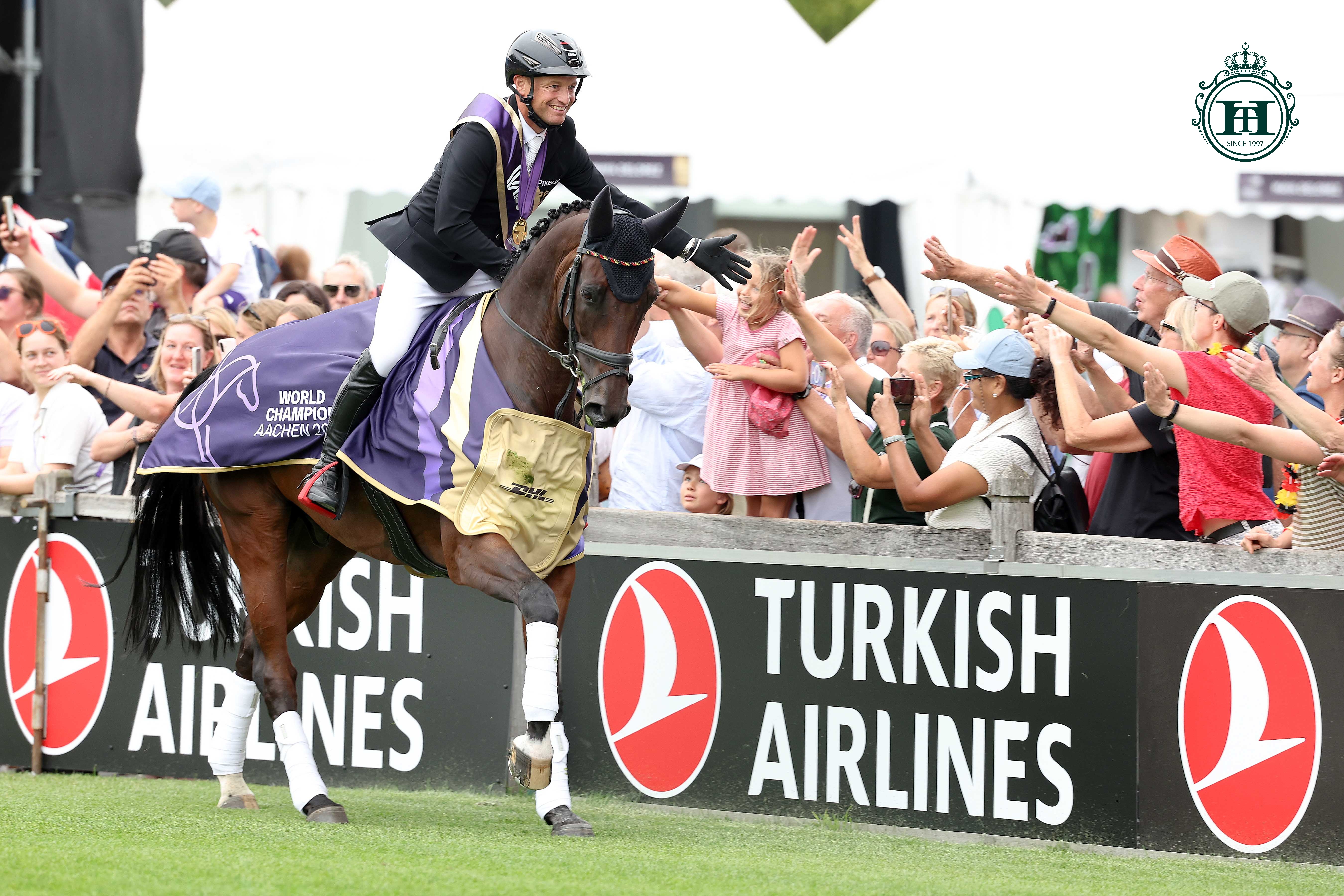
EVENTING AT THE FEI WORLD CHAMPIONSHIPS WAS AT ITS FINEST


(No part of this article may be copied or reproduced in any form without the permission of HT)
WHAT AN OUTSTANDING SHOWCASE OF PARTNERSHIP, TRUST AND COURAGE WAS THE EVENTING AT THE FEI WORLD CHAMPIONSHIP, WHERE FISCHERCHIPMUNK FRH WON GOLD AT 18 YEARS OF AGE WITH MICHAEL JUNG FOR GERMANY. LONDON 52 IS ALREADY 17 YEARS OLD AND WON BRONZE FOR GREAT BRITAIN UNDER THE SADDLE OF LAURA COLETT.
CROSS-COUNTRY
The cross-country was absolutely mind-blowing. In front of 35,000 spectators, the horses showed extraordinary heart and courage, while the partnerships between horses and riders made the day particularly special. London 52’s round was perhaps the clearest example. After losing a shoe and slipping three times, he managed to regain his balance and finish third. Each of his shoes had been fitted with studs to provide grip on the grass, yet he suddenly had to continue on only three. The way Laura Collett and London 52 responded revealed the value of years of partnership and mutual trust.
THE STRENGTH OF HOLSTEIN BREEDING
Seven of the horses in the top twenty after the dressage and cross-country phases were Holstein-bred. The Holsteiner Verband currently occupies second place in the WBFSH studbook ranking for eventing horses. “The success of these event horses is remarkable,” said Dr Thomas Nissen, who served as breeding director of the Holsteiner Verband for almost forty years. “The Holsteiner is ideally suited to this sport: it has a strong willingness to perform, a good canter and considerable jumping ability. Its basic gaits are generally sufficient, while Thoroughbred blood combined with powerful performance dam lines provides an excellent foundation.”
Of those seven horses, three were sired by Diarado, the current leader of the WBFSH sire ranking for eventing horses. The field also included Denim, an eleven-year-old Holstein-bred gelding by Dinken, a son of Diarado. Dinken is a hidden treasure among the Holsteiner Verband stallions. I have known him since he was two years old and have always felt a special connection with him, so seeing one of his offspring at his first five-star championship made me immensely proud. I spoke to American rider Phillip Dutton about Denim, who had not originally been intended for this competition. When Dutton’s first-choice horse was injured, the son of Dinken was called up as his replacement and made his five-star debut against an exceptionally strong field.
“I was fortunate that Denim was selected, it was a big step up for him,” Dutton explained. “I thought he was a little unlucky with his dressage score on the first day, because he actually performed very well. His cross-country round was very good too. He is not the fastest horse, but he is a real trier, a beautiful jumper and very brave.”
According to Dutton, Denim is still developing the confidence and fitness required at this level. “Some horses have to learn to trust themselves when they are galloping fast. Not every horse naturally feels comfortable at that speed; it can worry them a little, and Denim is a bit like that. We have spent time helping him become more confident about going faster. He is also quite sensitive to dust and allergies, so I am always working to keep his airways healthy and prevent inflammation.”
Asked about Denim’s greatest qualities, Dutton praised both his attitude and athletic ability. “He is such a willing horse. He likes being ridden and enjoys his work; he never tries to avoid it. He is forward-thinking, a good mover, a good jumper and a real athlete. When you put all of that together with a good brain, you have a very complete horse.”
The conversation also turned to the striking number of Diarado offspring competing in eventing at the highest level. Dutton believes the stallion is having a considerable influence on the discipline. “Diarado is having a huge impact, not only here but on the sport in general. In eventing, you need a horse that can gallop, that is tough enough to cover three or four miles across country, and that can still be competitive in the dressage and showjumping. His offspring are proving to be excellent event horses.”
Dutton hopes that Denim could eventually develop into a candidate for the 2028 Olympic Games in Los Angeles. “That is what we are aiming for, along with many other combinations. By then, he should be in his prime. He will be two years older, more experienced and hopefully that much better. What he has already achieved here is pretty impressive.”
FROM A FOAL ON FÖHR TO THE TOP OF INTERNATIONAL EVENTING
For breeder Ocke Riewerts, watching London 52 compete with Laura Collett was anything but relaxing. The margins were extremely small and the tension continued to build throughout the competition. Moreover, Riewerts was unable to follow every detail. “I was mainly occupied with the press and had not even heard what had happened with the shoe!” That only made his delight at another outstanding result for the horse he bred even greater.
The Holstein-bred gelding by Landos out of the State Premium mare Vernante (Quinar) was born in 2009 at Riewerts’ farm on the North German Island of Föhr. Riewerts sold London 52 as a foal and did not see him again until many years later, when the gelding won the CCI5*-L at Luhmühlen in 2023. Nevertheless, he closely followed the horse’s development. “When you look at the path he has taken, it is fantastic to see what he is achieving now. And it is not just a one-off result: he has been among the very best in the world for years.”
Choosing Landos for Vernante was a carefully considered decision. The stallion stood on Föhr for a period and was also available there for natural covering, allowing Riewerts to become familiar with his qualities and the type of mare that suited him. “Landos was a little crazy, but in a positive way-and a good horse needs a touch of that.” Riewerts’ family had already been breeding from Vernante’s dam line for generations.
London 52’s success has encouraged Riewerts to take a much greater interest in breeding for eventing. At the same time, he recognises how challenging the market can be for breeders. A promising eventing foal generally commands considerably less than one with an obvious showjumping or dressage pedigree. “If you breed for eventing, I feel you almost have to sell horses that are already trained and ready to compete. The price of a good eventing foal simply is not very high.”
Riewerts does not regard the relatively limited selection of specialist eventing stallions as an insurmountable problem. For him, the foundation lies in the dam line. “I have the right maternal family. Now I simply need to find a stallion with enough ambition, drive and blood. Those stallions can still be found.” With London 52, Riewerts has convincingly demonstrated that a traditionally bred Holsteiner can rise to the very highest level of international eventing.
TEAM SPIRIT AND EXCEPTIONAL HORSES DEFINE AACHEN MEDAL BATTLE
After the Team and Individual Jumping, the medal-winning teams reflected on an extraordinary week in Aachen. Great Britain had most reason to celebrate, securing team gold alongside individual silver for Rosalind Canter and bronze for Laura Collett.
Chef d’équipe Richard Waygood praised both the quality and unity of his team. “It’s amazing to work with these guys. Fantastic horses, fantastic riders – it makes life so easy. What’s more, they’re all really good friends and they all have each other’s backs.”
Great Britain had arrived with high expectations. “We came in with a lot of weight of expectation on our shoulders, so for these guys to deal with that pressure is absolutely incredible. Of course, there is a bit of relief afterwards as well.”
According to Waygood, that team spirit is characteristic of eventing. “For 350-odd days of the year, everybody is competing against each other, but eventing has such a family feeling. There are very few sports where athletes from different nations will tell each other: ‘Be careful around that corner, it might be slippery.’”
YEARS OF TRUST
Individual silver medallist Rosalind Canter has ridden Lordships Graffalo since he was three years old. “I absolutely love him, and I think we complement each other well,” she said, while also crediting his owners. “Michele and Archie have been in the sport for many, many years and they’re fully behind what we do.”
Laura Collett’s cross-country round had provided considerably more drama. Her horse lost a shoe and slipped badly approaching the final water. “I’ve seen a photo and I don’t really know how he stayed up, let alone jumped the fence into the water. At that point, he just showed what an amazing horse he is. He knew exactly what was required of him.”
Collett could only praise what her horse had given her throughout the championship. “In all three phases, he’s given it everything, like he always does. I’m just super lucky to ride him.”
GERMAN SILVER
For Germany, team silver was the result of a collective effort. Julia Krajewski explained that Aachen had been a long-term goal. “It’s something you really want to be part of, and I think we all worked towards it.”
She particularly emphasised the people behind the scenes. “Everybody, the farrier, the physios, the grooms, everyone around us – put so much effort into it. If you can bring home a team medal, it’s very emotional. It’s something you can give back to everybody who is behind you for the rest of the year.”
A FAIRYTALE FOR FISCHERCHIPMUNK
Perhaps the most emotional story belonged to Michael Jung and the 18-year-old fischerChipmunk. Jung immediately thanked the Fischer family. “I was so lucky to get fischerChipmunk. Without them, I would not be sitting here and enjoying this week in Aachen.”
Even at 18, the gelding continues to excel in all three phases. “He is such a super dressage horse. He has such good balance, a super temperament and so much rideability. Then, in the cross-country, he is powerful and can run so fast.”
Jung remains fascinated by his ability to switch from cross-country to jumping. “Running completely flat out in the cross-country, jumping so bravely, and then coming back and jumping so carefully and in such a super style. I’m just thankful to have this horse. He makes it much easier for the rider.”
There was one heart-stopping moment in the final jumping round when fischerChipmunk came perilously close to two poles. “That was a very scary moment,” Jung admitted. “But the rest, he was amazing today.”
For Julia Krajewski, who produced fischerChipmunk up to championship level before Jung took over the ride, his continued success remains emotional. “We were in Paris together and I cried when he won gold there, and today again. fischerChipmunk has always been an incredible horse. What they manage to pull off under pressure, when it matters, again and again, is absolutely incredible. It’s a massive credit to Michael’s work and management.”
USA FIGHTS BACK
The United States climbed from sixth after dressage to fifth after cross-country and ultimately secured Team Bronze. William Coleman credited their resilience. “We didn’t get off to the greatest start, but everybody kept a really cool head and we just kept chipping away throughout the weekend.”
Phillip Dutton agreed. “It was a bit of a tough week for us. We were left behind in the first couple of days, and to be able to come back and be sitting up here is something for us all to remember and something to be proud of.”
For Dutton, Aachen 2026 also carried historical significance: twenty years after competing at the 2006 World Championships at the same venue, he returned to contest another World Championship in Aachen.
Across all three medal-winning teams, the message was remarkably similar. Medals may be decided over a few intense days, but they are built over years – through partnerships with exceptional horses and the work of the entire team behind them.
WORLD CHAMPION FISCHERCHIPMUNK FRH IN A LEAGUE OF HIS OWN
At the age of eighteen, the Hanoverian-bred fischerChipmunk FRH (Contendro I – Heraldik xx) looked remarkably fresh and in outstanding form. Once again, his exceptional partnership with Michael Jung proved fundamental to their success. After the dressage and cross-country phases, the pair held the overnight lead.
With every jump, Chipmunk’s owner and breeder Hilmar Meyer-Kulenkampff appeared to ride along from the riders’ lounge. Visibly moved by the performance, he expressed his delight immediately after the cross-country. “I am very happy with the result. I have been breeding from this dam line for ten generations. In the past, we did not have the internet. I studied agriculture and specialised in equine genetics, while my grandfather told me a great deal about the history of the earlier generations in our breeding programme. I also began purchasing the English Thoroughbred Stud Books published by Weatherbys.”
Meyer-Kulenkampff has always had a particular interest in the blood of the influential Thoroughbred sires Nearco xx (Pharos xx – Nogara xx, by Havresac II xx) and Hurry On xx (Marcovil xx – Toute Suite xx, by Sainfoin xx).
“Both have played an enormously influential role in Warmblood breeding, and their blood remains important today. That knowledge formed the basis on which I bred Chipmunk. He carries Nearco xx five times in his pedigree and Hurry On xx three or four times. I combined that Thoroughbred influence with the blood of Ramiro and Ramzes x, which contributes willingness to perform, jumping power and rideability. Even today, I still look specifically for Nearco xx and Hurry On xx when studying pedigrees.”
The final piece of the puzzle was Chipmunk’s sire, Contendro I (Contender – Bravo, by Reichsgraf), bred by Manfred Birchler. “Contendro I himself carries Ramzes x five times in his pedigree. I chose him because I valued his willingness to perform, his rideability and the complete package he offered, together with his connection to Thoroughbred blood.”
Chipmunk’s development into one of the greatest event horses of his generation was therefore no coincidence. “I genuinely bred Chipmunk with eventing in mind,” Meyer-Kulenkampff concluded. “It was my intuition, and that was the purpose behind the entire combination.”
BACK TO WHERE IT ALL BEGINS
After all the medals had been awarded, the final words were reserved for the people at the very beginning of every successful sport horse’s story: the breeders. I asked what Michael Jung, Laura Colett and Boyd Martin. whatwould they like to say to them? Laura Collett’s answer was simple: “Thank you very much.” Her appreciation goes beyond words. Next year, Collett is planning to return to the same breeder to buy a foal by Landos, the sire of her London 52, conceived using frozen semen.
Michael Jung, who has also ventured into breeding himself with his mare Okana, knows from experience how much work goes into producing a horse long before it ever enters a championship arena. “The breeders put in all the work and effort at the beginning. I started breeding myself a few years ago with Okana, and it is so nice, but also a lot of work. A big, big thank you to the breeders for doing all this. And, for sure, it would be nice if we had a few more horses like these.” Julia Krajewski was quick to point out that there are still several siblings of fischerChipmunk. Perhaps there is another champion among them?
Boyd Martin, meanwhile, had one final request for the breeders. With a smile, he added: “Just try to breed a less spooky horse.”
IT WAS SPECIAL
In front of 35,000 spectators, Aachen’s cross-country revealed far more than speed and spectacular jumping. Denim’s willingness, London 52’s fighting spirit and fischerChipmunk FRH’s pedigree showed three sides of the modern event horse. These performances rest on training and trust, but their foundations are laid generations earlier by breeders who know their dam lines, value Thoroughbred blood and follow their intuition. In Aachen, sport and breeding came together and the horses showed how powerful that combination can be. HT
About the Author:
If there’s a world-class sport horse on the grounds, Adriana van Tilburg likely knows its entire family tree by heart. We know her well from her endless roving trips across the international circuit, where her wonderfully conversational style makes her a joy to read. An international equestrian journalist and bloodline specialist, she turns complex breeding dynamics into cracking good stories, bringing you the tell behind the tale.