

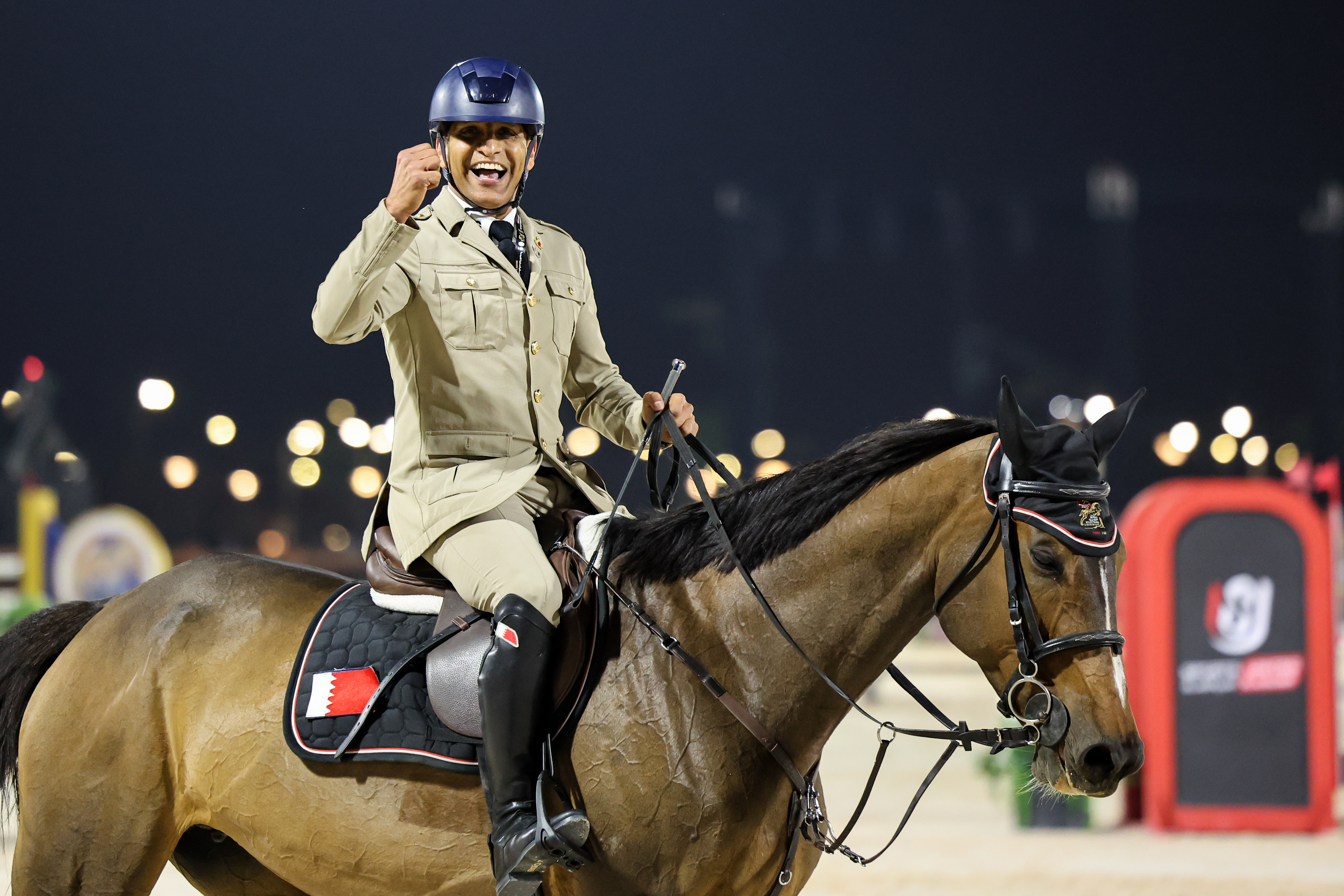
SAMI GHAZWAN PERPETUATES THE RICH LEGACY OF HIS FAMILY


(No part of this article may be copied or reproduced in any form without the permission of HT)
HORSES HAVE BEEN IN THE GHAZWAN FAMILY FOR FOUR GENERATIONS. FROM HANDLING RACEHORSES AT THE BAHRAINI ROYAL STABLES IN THE LATE 1940S AND GAINING KNOWLEDGE IN THE UNITED KINGDOM, TO CREATING THEIR EQUESTRIAN CENTRE IN 1969 AND ORGANISING THE FIRST OFFICIAL BAHRAINI SHOWJUMPING COMPETITION IN 1984, THE GHAZWANS WERE EQUESTRIAN PIONEERS ON THE ISLAND. HORSE TIMES SAT DOWN WITH SAMI TO GO BACK IN TIME AND GET HIS VIEW ON HOW SHOWJUMPING IS EVOLVING TODAY IN BAHRAIN.
1. Your father, the late Mohammed Ghazwan, founded the family equestrian centre in 1969. What inspired him to start such a project at a time when organised equestrian sport in Bahrain was still in its infancy?
My late father inherited his love for horses from my grandfather Jaffar, who inherited the same from my great-grandfather Mohamed. Horses are part of the Ghazwan family’s DNA. My father and his brother worked for Bahrain's former ruler, the late Sheikh Salman bin Hamad Al Khalifa, grandfather of the current King of Bahrain, His Majesty King Hamad bin Isa Al Khalifa. They were both working as horse racing jockeys at the Safra Horse Racing Track back in the '50s and '60s. From there, my father decided to open a horseback riding school. The idea came after a meeting with His Majesty the King, who supported the project.
2. Your father organised the first official showjumping competition in Bahrain. What do you remember about that milestone event and the atmosphere surrounding it?
He decided to organise the first official showjumping competition after his return from the UK, where he competed in many shows back in the '70s. He wanted to introduce showjumping to local stables in Bahrain. In those days, only a few European riders living in Bahrain were practising showjumping; just a handful of Bahraini riders were into the discipline. The 1984 official showjumping competition was an important event in terms of scale. I remember many Bahraini government officials attended as VIPs. I will also never forget winning my first competition as a Junior. It was simply magical and the start of many future successes and victories.
3. What were the main challenges your father faced in developing showjumping in Bahrain during those early years?
The majority of Bahraini riders were interested only in racing and speed rides. When showjumping was introduced, the majority carried over their racing style to showjumping, keeping speed as the priority to clear any obstacle. My father visited several stables to try to teach riders the proper basic flatwork and jumping techniques. Since that day, I have carried on his legacy and am still coaching well-known Bahraini riders today. Currently, with the assistance of Dawood Ahmed, who created David Equestrian Services, we have set up several showjumping clinics for Bahrainis with the intent to review all showjumping basics. The first clinic took place at my stables on 14 March 2026. It was so well received that we have scheduled a second clinic on 27 March 2026.
4. How did growing up in such an environment influence your own path as a rider and later as a coach?
I grew up surrounded by horse lovers, listening to their racing stories and visiting the race track regularly. I wanted to take a different path and showed a great interest in showjumping. I cannot thank my father enough for sending me to the UK in 1986 to sharpen my skills.
The experience was an eye-opener for me, and since then, I have never stopped developing both my horses and myself. Naturally, a few years later, I was selected to ride for the first Bahraini showjumping team. This was a milestone in my career—the result of many years of hard work and success as a young rider in local shows. I eventually took part in my first international competition in 1989 at the Dubai Dunhill International Show, held where the Dubai Racecourse is located today. Success has never left me since. I have set up a gallery at my riding centre that houses over 500 trophies. My last major victory was first place at the World Military Equestrian Championship organised in Egypt in May 2025.
To build on this momentum and give back to the sport, I use social platforms to transfer my knowledge through training videos covering all aspects of horsemanship. I am glad that thousands of followers from across the Arab world appreciate and benefit from them. In a way, I am simply keeping up with the family tradition and the legacy of promoting horsemanship.
5. How has showjumping in Bahrain evolved from the early days of the 1970s and 1980s to the present?
Showjumping in Bahrain kicked off in 1984. It evolved as a local sport until the government established the Bahrain Royal Equestrian Federation in 2003. This body set up rules and regulations, supported competitions financially, and provided substantial awards for winners. Then, the first international competitions were organised under the International Equestrian Federation (FEI) umbrella. This definitely promoted showjumping and encouraged more Bahrainis to become showjumpers. As the years pass, racing and endurance remain ahead of showjumping and dressage in terms of popularity in the Kingdom. The federation releases yearly showjumping and dressage calendars with their respective national championships. Additionally, one international showjumping competition is usually organised in February. Due to the many attractive showjumping tours in the region (Qatar, Saudi Arabia, and the UAE), it is difficult for Bahrain to attract professional riders from abroad. Our last international competition a month ago featured only three nationalities: Bahrain, the UK, and Ireland. All riders and horses were based on the Island; unfortunately, no one came from abroad. There is a huge margin for progression for our sport in Bahrain; therefore, there is hope for a bright future.
6. What role did your family’s equestrian centre play in developing new generations of riders in Bahrain?
Since the establishment of the Ghazwan Equestrian Centre, a large number of riders have benefited from our diverse programs. It continues to do so by graduating young and adult riders in both dressage and showjumping.
7. Looking back, which moments make you most proud when you think about the Ghazwan family’s contribution to the sport?
Whenever I hear or read an interview with a Bahraini rider who mentions that their first step in horseback riding was at the Ghazwan Riding Centre, it makes me proud.
8. What advice would you give to young Bahraini riders who dream of following a similar path?
Patience is key for me. You know as well as I do that "Rome wasn’t built in a day." Any rider must ensure they complete their "mileage" as an amateur in novice classes before moving up to more advanced levels.
9. Finally, how would you like the legacy of the Ghazwan family to be remembered in the history of equestrian sport in Bahrain?
I would humbly say that the Ghazwan family name is well established. It has been known in the field of horseback riding for many decades.
As long as our equestrian centre is running with its great team of dedicated grooms and instructors, I have no doubt that our family name will always be remembered. I am doing my part to follow in the footsteps of my predecessors, and I hope that my children and grandchildren will continue to build on this momentum. HT
Photo by the Egyptian Equestrian Federation